Title: Redundant & Efficient DC/DC System for Electromobility (REDSEL)
Project lead: Albert Frank
Program: Zero Emission Mobility
Funding Agency: FFG – Austrian Research Promotion Agency
Project Duration: 24 months (since March 2024)


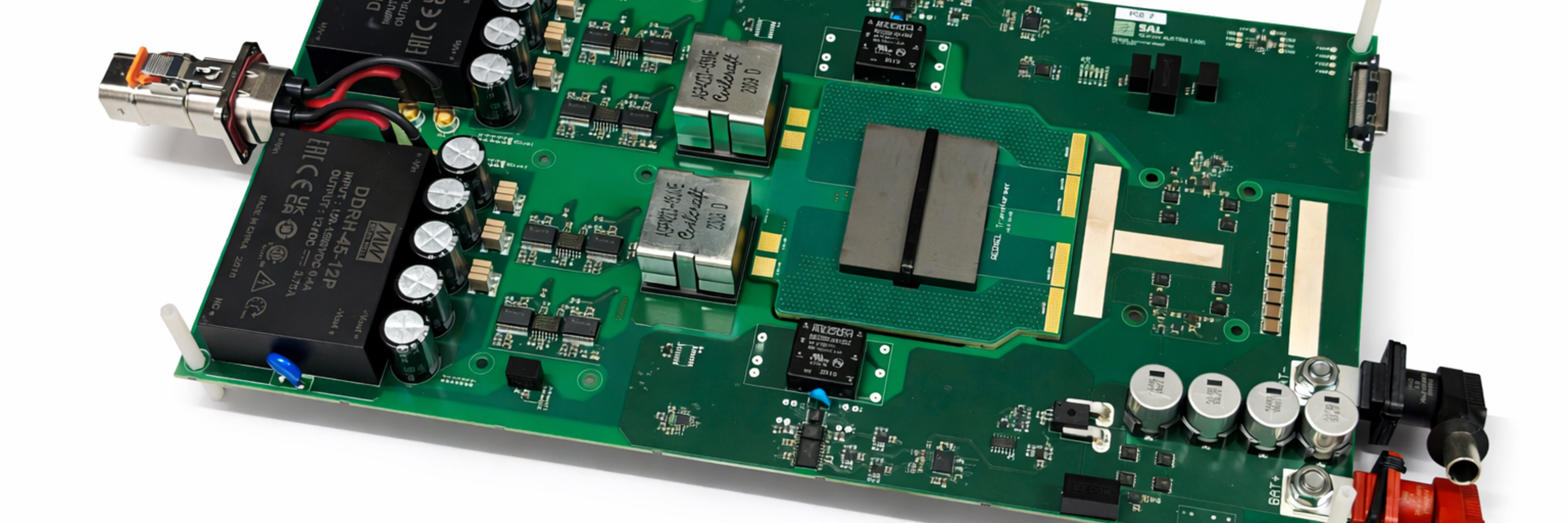
The increasing demand and continuously evolving regulatory requirements for compliance with CO₂ emissions have prompted various automotive original equipment manufacturers (OEMs) to rethink key aspects of energy distribution within electric vehicles. However, a unified approach to energy supply—covering not only electric motors but all vehicle subsystems—has yet to emerge. This situation is further exacerbated by the significant increase in power demand and system reliability requirements of future vehicles.
While vehicles with internal combustion engines have traditionally required power levels between 600 W and 3 kW, future vehicles are expected to demand significantly more than 3 kW due to additional functionalities (e.g., autonomous driving). It is evident that increasing vehicle functionality places a substantial burden on the low-voltage onboard power network. These additional requirements primarily have a negative impact on the reliability of electric vehicles, which is a critical safety-related factor—particularly for autonomous vehicles—and necessitates new, more reliable architectures.
Within this project, different concepts are evaluated for specific operating conditions and assessed according to criteria such as reliability and efficiency, while also considering the trade-off between reliability and additional size and weight.
Furthermore, a comparative analysis of the concepts aims to determine whether a system has the potential to completely replace the low-voltage battery, thereby further reducing weight and improving the overall efficiency of electric vehicles.
Title: Redundant & Efficient DC/DC System for Electromobility (REDSEL)
Project lead: Albert Frank
Program: Zero Emission Mobility
Funding Agency: FFG – Austrian Research Promotion Agency
Project Duration: 24 months (since March 2024)



DI Albert Frank
Head of Research Unit | R&D Services - Electronics
E-mail: contact@silicon-austria.com

Member Area
Login